
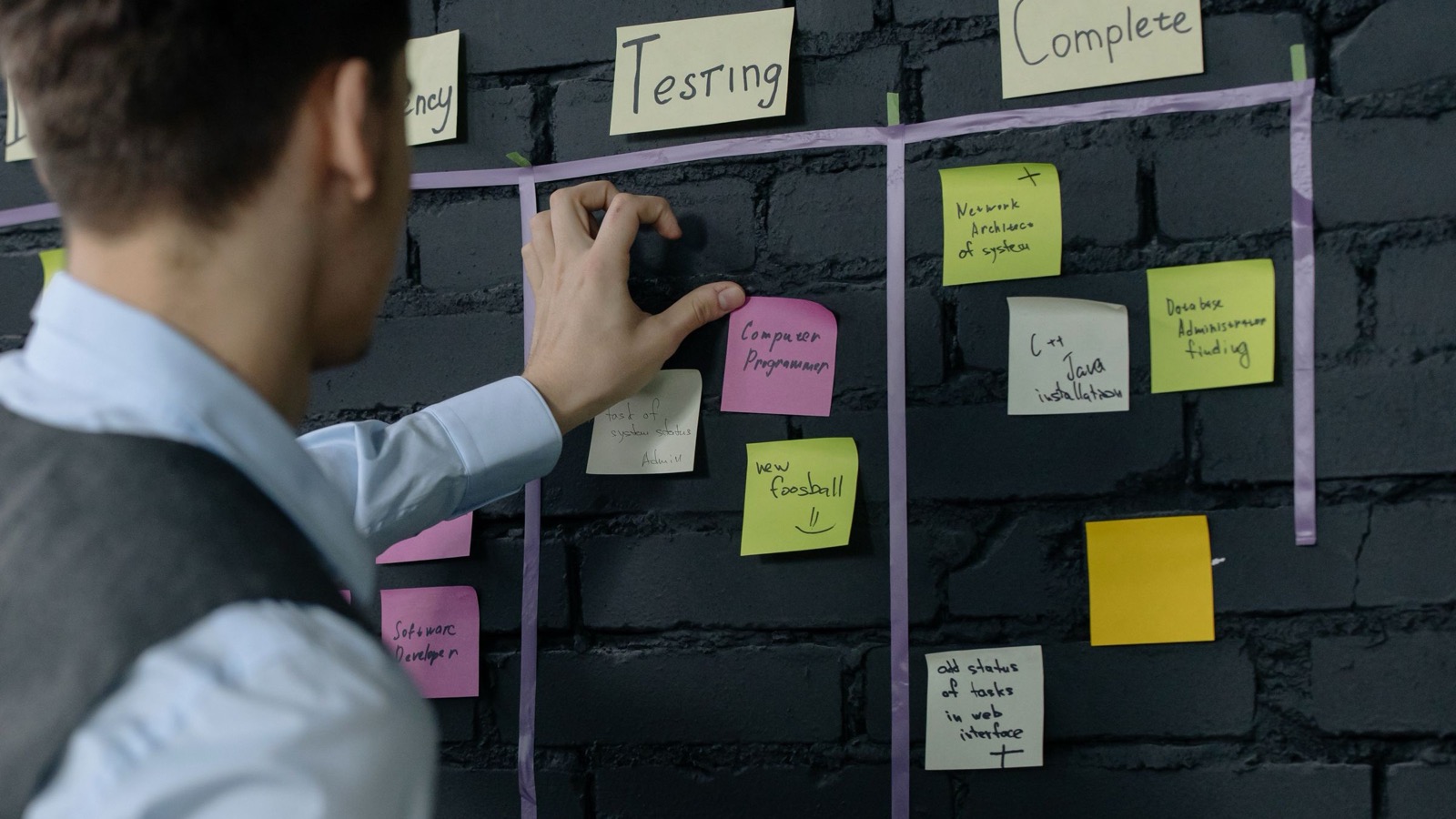
Can we manage projects not only more efficiently, but also see risks earlier, make better decisions and get better business results?
For a long time, the honest answer was "partly." A project manager spends much of the week tracking tasks, chasing updates, building status reports and checking the budget. By the time a problem shows up clearly in the report, it is often already expensive.
AI gives us a reason to rethink the role. Not to replace the project manager, but to move the job away from tracking and towards something more useful: active, data-based management that spots risks early and compares options before a decision is needed.
I see three areas where AI can create real business value. They build on each other, and most organisations stop at the first one.
1. Less Manual Work, More Time for Real Management
The first area is the most obvious. A lot of a project manager's week goes to routine work that a tool can now do well.
Meeting summaries The tool records the decisions, the open questions and who owns each action, so nobody has to rebuild them from memory.
Status reports Data from the task system, the timeline and the budget comes together in one place, without someone copying numbers by hand every Friday.
Task follow-up Overdue items and missing owners are flagged automatically, instead of being found in the next meeting.
This frees time for planning, for leading people and for solving problems. But it should be treated like any other investment. Measure the time and cost it saves, and compare that to what it costs to set up and run. If the saving is real, keep it. If it is a feeling, find out why before you expand it.
Efficiency matters. It is also the least interesting part of the story.
2. From Late Surprises to Early Warnings
Most projects do not fail suddenly. They drift. A task slips by two days, then another task that depends on it slips too, and a few weeks later the launch date is at risk. Each step was visible on its own. The pattern was not.
This is where AI starts to change how a project is managed, not just how fast it is reported.
By analysing progress data, the dependencies between tasks and patterns from earlier projects, AI can help point out early signs of delay or budget overrun. Not as a prediction you have to trust blindly, but as a signal worth checking: this part of the plan looks like the parts that slipped last time.
That lets the project manager rank risks, act while there is still time, and reduce the effect on the project's goals. The conversation with management changes too. Instead of "we have a problem," it becomes "we see a risk forming, and here is what we suggest."
3. From Reporting Problems to Supporting Decisions
The third area is where I think the real value lies.
Imagine a critical task is delayed, and the launch may move by three weeks.
The usual response is to update the timeline and report the delay to management. The project manager has done their job, and management now has a problem with no shape.
With AI, the project manager can do more. They can analyse the effect of the delay, run a few scenarios and compare the options side by side:
- Add resources. Can more people or budget prevent the delay, and at what cost? Will new people actually speed things up, or slow the team down while they learn?
- Reduce scope. Can some parts move to the next version, so the launch keeps its date? What do customers lose, and does it matter to them?
- Move the launch. What is the business cost of launching later? What do we gain by keeping the budget and the full scope?
Now management is not looking at a red line on a chart. It is looking at three clear choices, each with its cost, its benefit and its risk. The decision is based on business impact, not only on the status of tasks.
That is a very different role for the project manager. Less messenger, more advisor.
Where Organisations Go Wrong
The value of AI is not in using it. It is in what it does to the quality of management and the business results.
The most common mistake is to start with the tool. A team buys or switches on an AI feature, tries it on everything at once, and after a few months nobody can say whether it helped.
A better start has three parts. First, a clearly defined business need, such as "we find out about delays too late." Second, one process where AI can help with that need, not ten. Third, success measures agreed before you begin, so you can tell real improvement from enthusiasm.
And one thing does not change. AI can help analyse the situation and present options. The judgment, and the final decision, stay with the manager. A tool can show that adding two people might save the date. It cannot know that the team is already tired, or that a key customer cares more about one feature than about the date. People know that.
From Tool to Lever
If we choose the right process and measure the effect, AI stops being an operational tool and becomes a lever for better decisions and better business results.
Saving an hour on a report is nice. Seeing a three-week delay coming, and walking into the room with three real options, is what good project management was always meant to be.