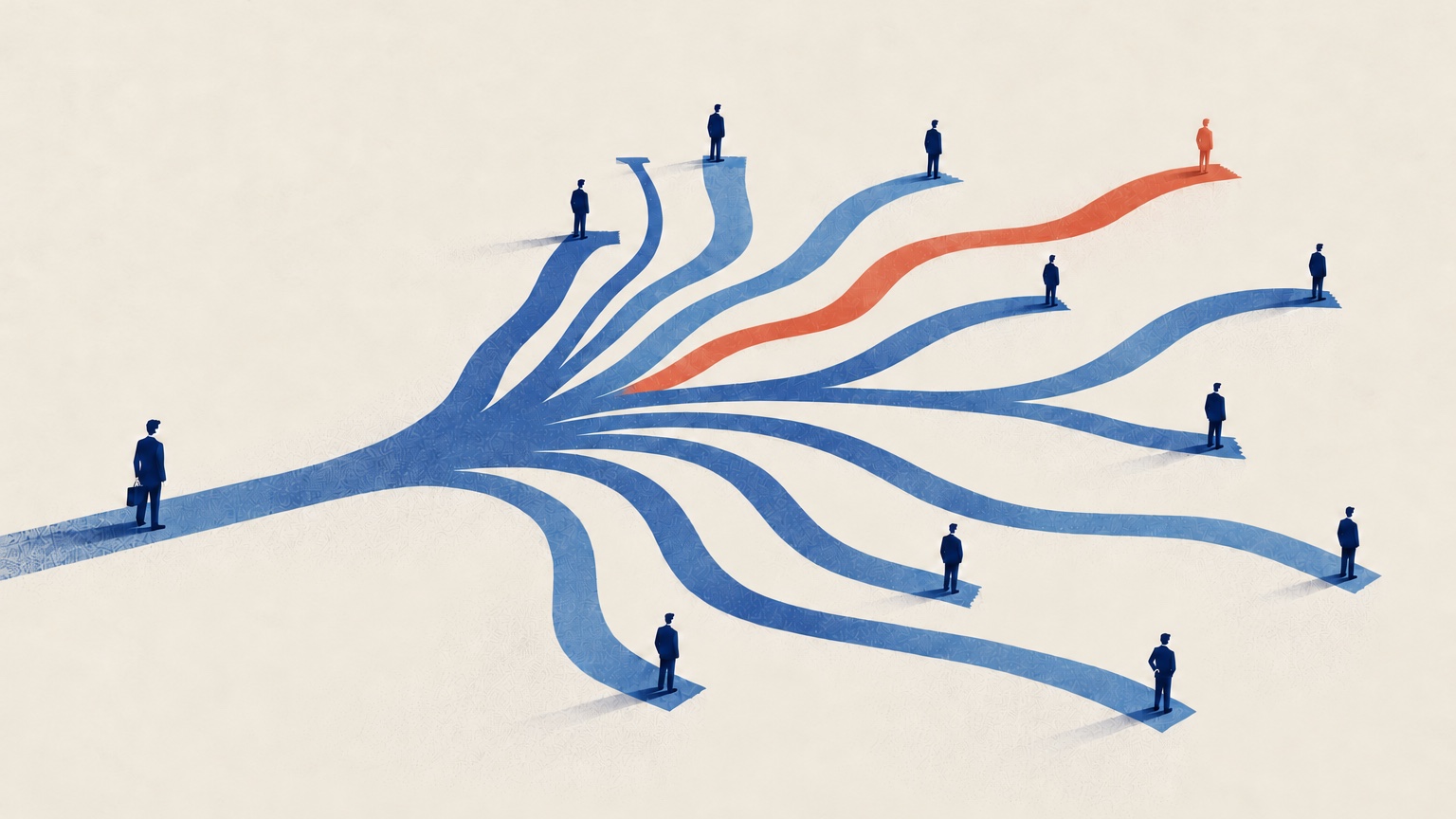
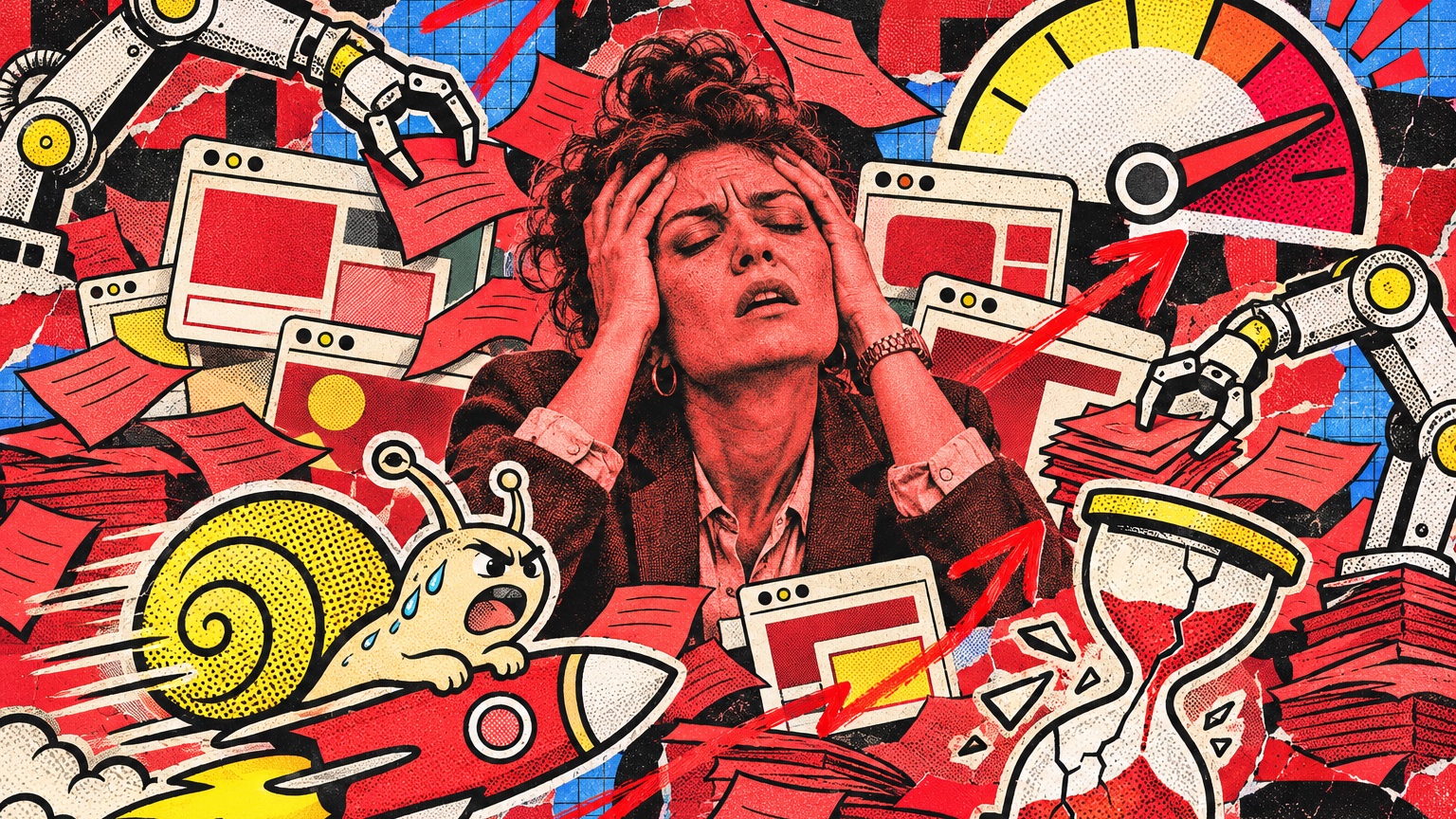
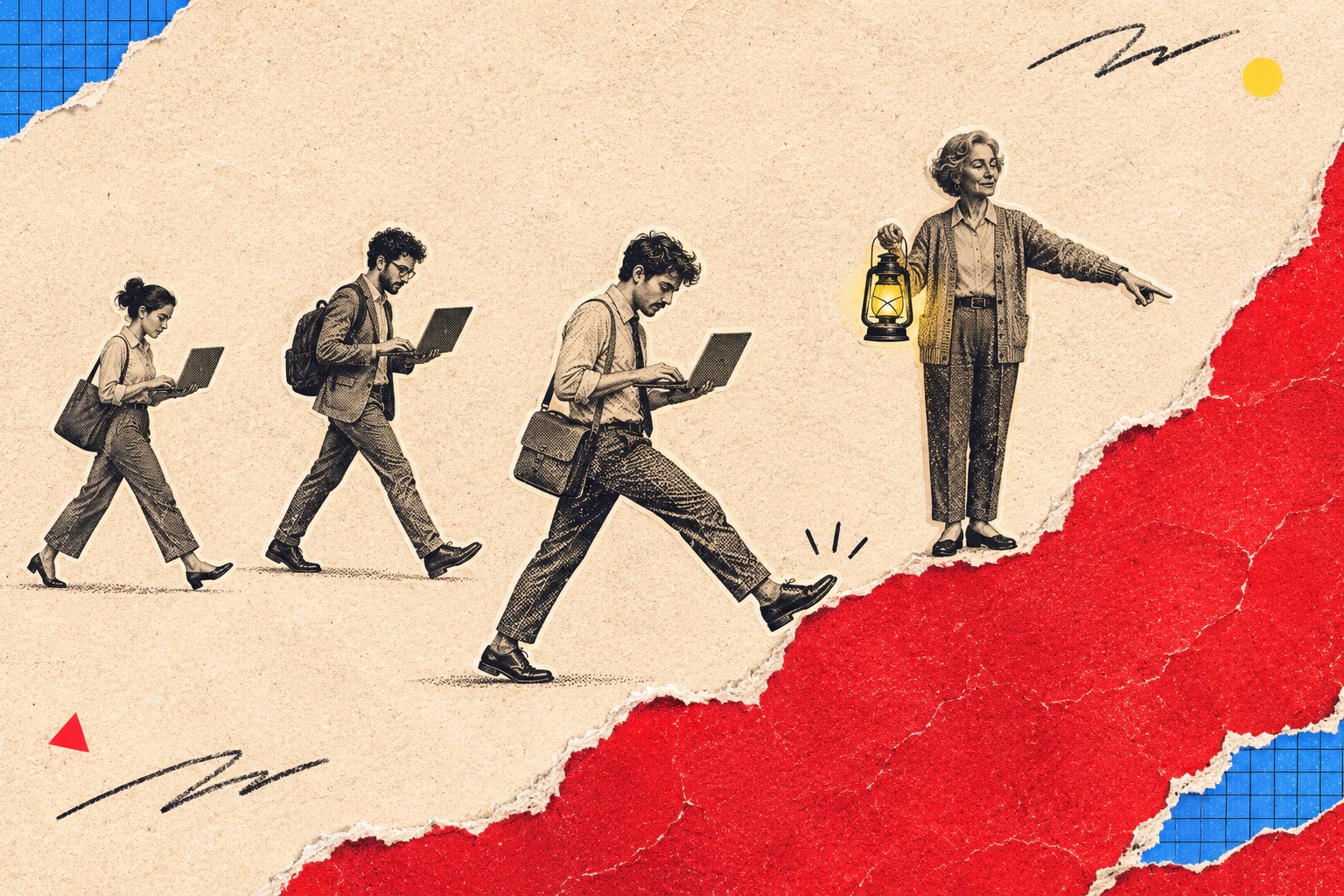
Picture a Monday morning. The first draft of the board report took forty seconds. Overnight, an AI agent opened six pull requests, and each one needs a human to read it. A product manager has three prototypes where last year there would have been one sketch. The new hire asks whether she should learn the old system at all, since "the AI knows it anyway".
By ten o'clock the team lead has made more decisions than she used to make in a week.
The work got faster. The day did not get shorter.
The tools change every few months. People learn more slowly, and the gap between the two is where much of the real cost now sits.
More output, more judgement
The promise was simple. AI takes the routine work, and people get time back. For some tasks that is exactly what happens. For many teams, the time comes back in a different shape.
In 2024 the Upwork Research Institute surveyed 2,500 workers and executives. Ninety-six percent of the executives expected AI to raise productivity. Seventy-seven percent of the employees who used AI said it had added to their workload, and 39% said they now spent more time reviewing or moderating AI-made content. Upwork sells freelance work, so it has an interest in the answer, and these are reported feelings, not measured output. They are still worth taking seriously.
The reason is not mysterious. When drafts become cheap, people produce more of them. Most drafts still need someone to decide whether they are right and what comes next. The bottleneck can move from making things to judging them, and judging is often slower, more tiring and harder to delegate.
It also has a name when it goes wrong. In 2025, researchers at BetterUp Labs and the Stanford Social Media Lab called it "workslop": AI output that looks finished but does not move the task forward. About four in ten of the 1,150 American desk workers they surveyed said they had received some in the previous month, and they estimated that each case took close to two hours to sort out. The cost of a fast draft is often paid by the person who receives it.
The speed we feel and the speed we have
If more work is arriving, people should at least know whether they are going faster. Often they do not.
In 2025 METR, a research group that studies AI capability, ran a small but careful experiment. Sixteen experienced open-source developers worked on real tasks in projects they knew well, some with AI tools and some without. With AI, they took 19% longer. Afterwards they believed AI had made them about 20% faster. The authors are careful to say this was one setting, early in 2025, and that it does not prove AI slows everyone down. A follow-up in February 2026 suggested newer tools may help more, though METR said its own estimates there were unreliable. What the first study does show is that our sense of speed can be a poor instrument.
People adjust to what they feel. If the feeling says "faster" and the calendar says "fuller", the result is a strange kind of tiredness: busy, productive-looking, and never quite done.
Alvin Toffler saw a version of this in 1970. In Future Shock he described the stress of "too much change in too short a period of time", and warned that normal decision-making starts to break down under it. He was writing about society, not software, but the description fits a modern team surprisingly well.
What is my experience for?
The deepest worry is not about workload. It is about identity.
A senior engineer, a seasoned account manager or a head of finance has spent fifteen years learning how things are done. Now a tool does a passable version of their work in seconds. The quiet question is: if a machine can do this, what was all that experience for? And what am I now?
Some research seems to confirm the fear. In a 2023 working paper on more than 5,000 customer support agents, Erik Brynjolfsson of Stanford and his colleagues found that an AI assistant raised productivity by 14% on average, and by 34% for novices and less skilled workers. The final version, published in 2025, reports similar results. The most experienced agents gained very little. One reading is that AI flattens the value of experience.
There is another reading. The assistant learned from the conversations of the best agents, and the authors suggest it worked by spreading their habits to everyone else. On that reading, the experience did not disappear. It was copied, and the newer agents seem to have learned from it.
A 2023 field experiment with 758 consultants at Boston Consulting Group, led by Fabrizio Dell'Acqua of Harvard Business School, adds a sharper point. On tasks inside what the authors called AI's "jagged frontier", consultants with AI did more and did it better. On a task just outside it, those with AI were more likely to get the answer wrong, and their wrong answers sounded convincing. The frontier is jagged because tasks that look equally hard to us can sit on opposite sides of it. Knowing where the edge is, is a kind of experience.
The irony of the expert who stops practising
There is a catch, and it is an old one.
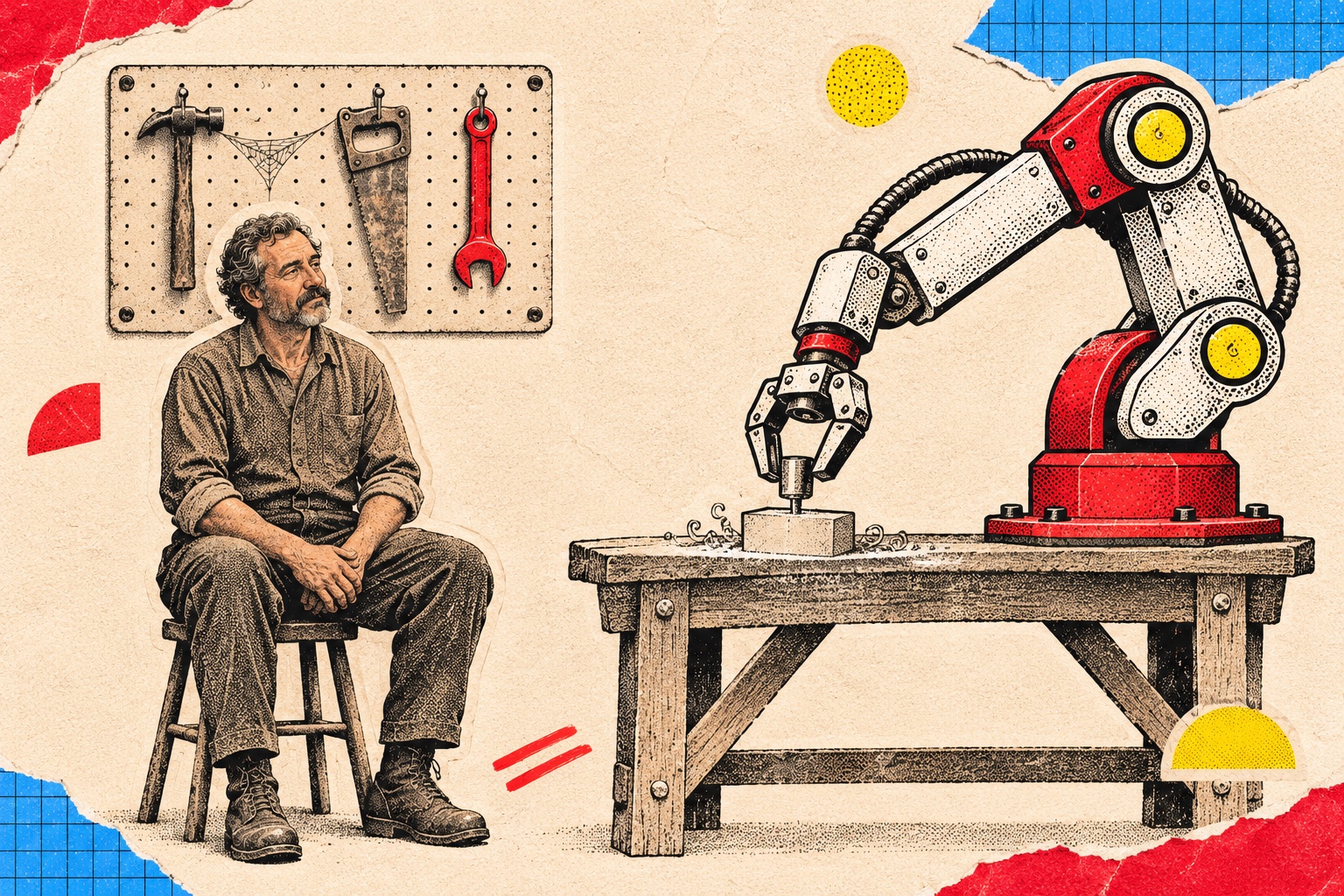
In 1983 Lisanne Bainbridge, a British psychologist, published a short paper called "Ironies of Automation". Her point was that when you automate most of a job, the human is left with the hardest parts: the rare, unusual moments when the system fails. But because the machine now does the everyday work, the human gets less practice. The skill fades just as it becomes most important.
A 2025 study by Microsoft Research and Carnegie Mellon University offers a modern echo. In a survey of 319 knowledge workers, those who trusted AI more for a task reported doing less critical thinking on it. Those more confident in their own abilities reported doing more. It is a snapshot, not proof that skills decline. It points the same way.
So experience is not finished. It is changing jobs. It used to be mainly the ability to do the work. It is becoming the ability to judge the work, to notice when something is wrong, and to step in on a bad day. Those skills grow from doing. A team that hands all the doing to the tool may slowly lose the people who can tell whether the tool is right.
In defence of the slow adopter
So far this essay has treated the human lag as a problem. It is fair to argue the other side.
Not every slow adopter is afraid or stubborn. Some have watched fast adopters send out confident, wrong work, and decided to keep checking. Some know their domain well enough to see where the tool falls off its frontier. The people moving fastest are not always the people moving forward.
Seen this way, part of the lag is a filter, not a failure. Organisations need some people who say "show me" before they say "yes". The real risk is when the filter is the only thing anyone does, or when nobody can tell the careful sceptic from the person who has quietly given up.
A people problem dressed as a tool problem
Ronald Heifetz of the Harvard Kennedy School drew a useful line between technical problems and adaptive challenges. A technical problem can be solved by experts with known methods. An adaptive challenge, in his account, requires people themselves to change. He argued that a common failure of leadership is to treat the second as if it were the first.
Rolling out AI licences is a technical task. Living with what they change is an adaptive one: who decides what, how much review a person can do in a day, and what a career is built on. Executives are not exempt. Their sense of "a reasonable amount of work" now sets everyone else's pace.
The speed of people
Back to that Monday morning. There is no formula for it, and I am suspicious of anyone selling one. There are better questions.
Who on your team makes more decisions than a year ago, and did anyone give them the time to make them well? Where has review become the real work, and is it counted as work? Which parts of your own experience were about doing the task, and which were about knowing what good looks like? Where do your people still practise the skills they will need on the day the tool is wrong?
The machines have learned to work faster. The open question is whether we will give people the time to learn at the speed people learn.